
If you're thinking about buying a house, one of the first questions you might have asked yourself is, "How much do I need to earn to qualify for a mortgage?"
It's a fair question, but salary alone does not automatically qualify or disqualify you from getting a mortgage.
Two people earning the same income can qualify for completely different mortgage amounts depending on their existing debts, credit history, deposit, and even the type of property they are buying.
Before speaking to a bank, it's worth getting an idea of what your monthly repayments could look like.
You can use PrimeVale's Mortgage Calculator to estimate your monthly mortgage repayments, compare terms from different banks, adjust your deposit, and even factor in upfront costs like stamp duty and legal fees.
It's Not Just About Your Salary
Most lenders don't just look at your payslip and decide how much they can lend you.
They go a step further:
Can you comfortably afford the monthly repayments while still meeting your other financial obligations?
This brings us to what is called the Debt-to-Income (DTI) ratio.
Understanding the Debt-to-Income Ratio
In Kenya, lenders do not want your total monthly deductions to exceed two-thirds of your gross monthly income.
These deductions include things like:
Existing bank loans
SACCO loans
Check-off loans
Salary advances
Car loans
Any other recurring debt repayments
Let's use an example.
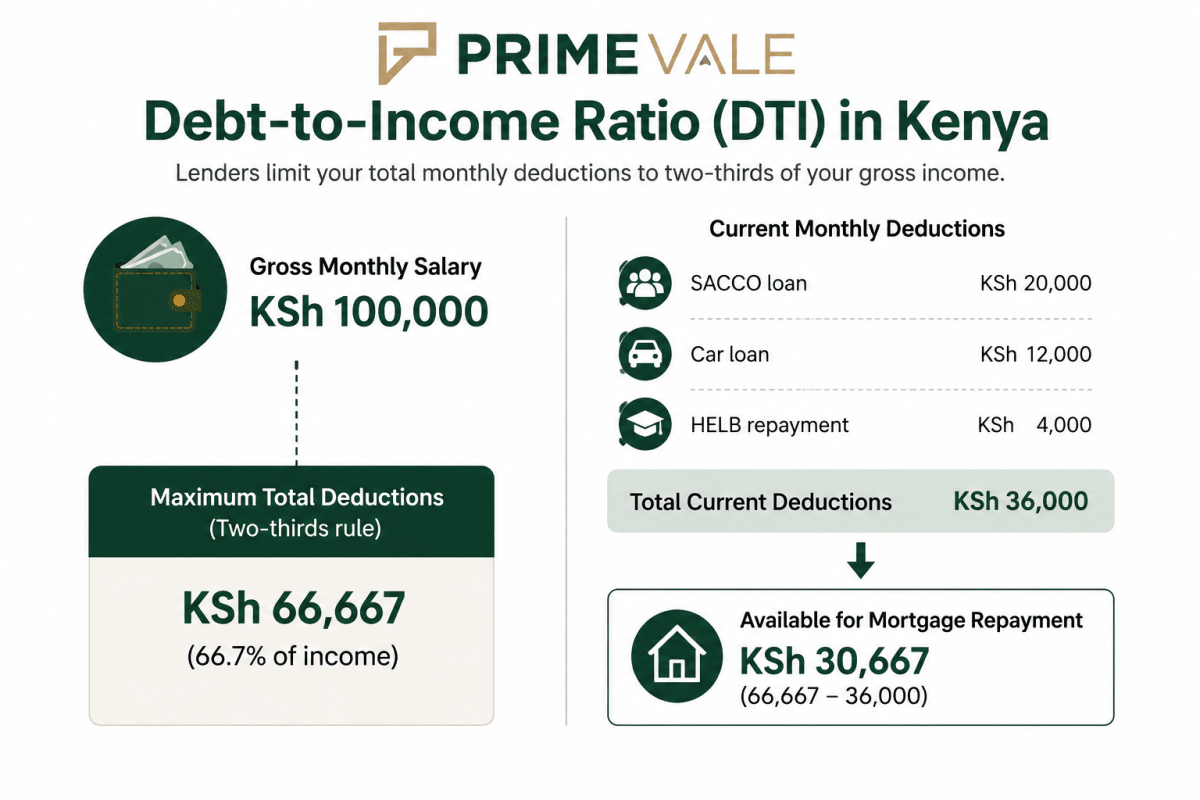
Suppose your gross monthly salary is KSh 100,000.
Your maximum total monthly deductions should generally not exceed about KSh 66,667.
Now imagine your deductions already look like this:
SACCO loan – KSh 20,000
Car loan – KSh 12,000
HELB repayment – KSh 4,000
That is KSh 36,000 already committed.
The bank will then assess whether adding a mortgage repayment still keeps you within the acceptable lending limits.
If it doesn't, the amount you qualify for may be reduced, even though your salary itself hasn't changed.
Your Credit Score Matters More Than You Think
A healthy salary alone does not guarantee mortgage approval.
Banks will also review your credit history through the Credit Reference Bureaus (CRBs).
You can check your credit score using the TransUnion app.
They want to understand whether you have consistently paid previous loans on time and whether you have a history of defaults or missed repayments.
Someone earning KSh 250,000 with poor credit could receive a smaller mortgage, or even be declined, while another person earning less but maintaining an excellent repayment history may have a much smoother approval process.
Keeping your credit record clean before applying for a mortgage can make a significant difference. So, if you have a poor rating, first aim to improve that before going ahead to apply for a loan.
Now Let's Talk About Your Deposit or Downpayment
Saving for a larger deposit often feels like the hardest part of buying a home, but it pays off in more ways than one.
A larger down payment:
Reduces the amount you need to borrow.
Improves your chances of mortgage approval.
Lowers your monthly repayments.
Reduces the total interest you'll pay over the life of the loan.
For example, if you're buying a home worth KSh 10 million, putting down a 30% deposit instead of 10% means borrowing significantly less. Over a 20 or 25-year mortgage, that difference can translate into millions of shillings saved in interest.
It also shows the lender that you've already built equity into the property, reducing their lending risk.
Lower Interest Rates Can Save You Millions as Well
The interest rate on your mortgage has one of the biggest impacts on what you'll ultimately pay.
That's one reason many first-time buyers are considering mortgages supported by the Kenya Mortgage Refinance Company (KMRC).
Through participating banks and financial institutions, eligible buyers, particularly those purchasing their first home, can access mortgage products with interest rates of around 9.5% per year.
While eligibility depends on the participating lender and the specific mortgage product, a lower interest rate means more of your monthly payment goes towards reducing the loan balance instead of paying interest.
Over the life of a mortgage, that can result in substantial savings.
What About SACCO Loans?
Not too long ago, many Kenyans financed their homes through SACCOs.
For our parents' generation, SACCOs were often the first stop when building or buying a home. They were trusted, community-driven, and in many cases offered easier access to financing than commercial banks.
Housing-focused SACCOs such as KUSCCO became well known for supporting members on their homeownership journey.
However, recent years have seen confidence shaken following financial challenges and allegations of mismanagement that affected KUSCCO and the wider cooperative sector.
As a result, many prospective homeowners are once again looking towards banks for long-term home financing, and that sometimes comes at a price.
That doesn't mean SACCOs no longer have a role to play.
Many still provide excellent savings plans, deposits, and affordable credit facilities. The key is to do your research and choose a financially sound institution before committing your savings.
So, How Much Should You Earn?
There isn't a magic salary that guarantees mortgage approval.
Banks look at the complete financial picture, that is, what we have talked about.
Let's summarize what that includes:
Your gross income
Existing debt obligations
Your credit history
The size of your deposit
The property's value
The interest rate available
Someone earning KSh 100,000 with minimal debt and a strong deposit could qualify more comfortably than someone earning KSh 180,000 but carrying significant existing loans.
That's why understanding your numbers before approaching a lender is so important.
Calculate Before You Apply
Before you start visiting show houses or speaking to a bank, take a few minutes to understand what a mortgage could actually cost you.
PrimeVale's Mortgage Calculator helps you estimate your monthly repayments, compare different loan terms, adjust your deposit, and understand the upfront costs involved in buying a home.
Once you've found a repayment that fits comfortably within your budget, the next step is finding the right property.
Browse our collection of apartments for sale across Kenya and start your journey towards homeownership with confidence.