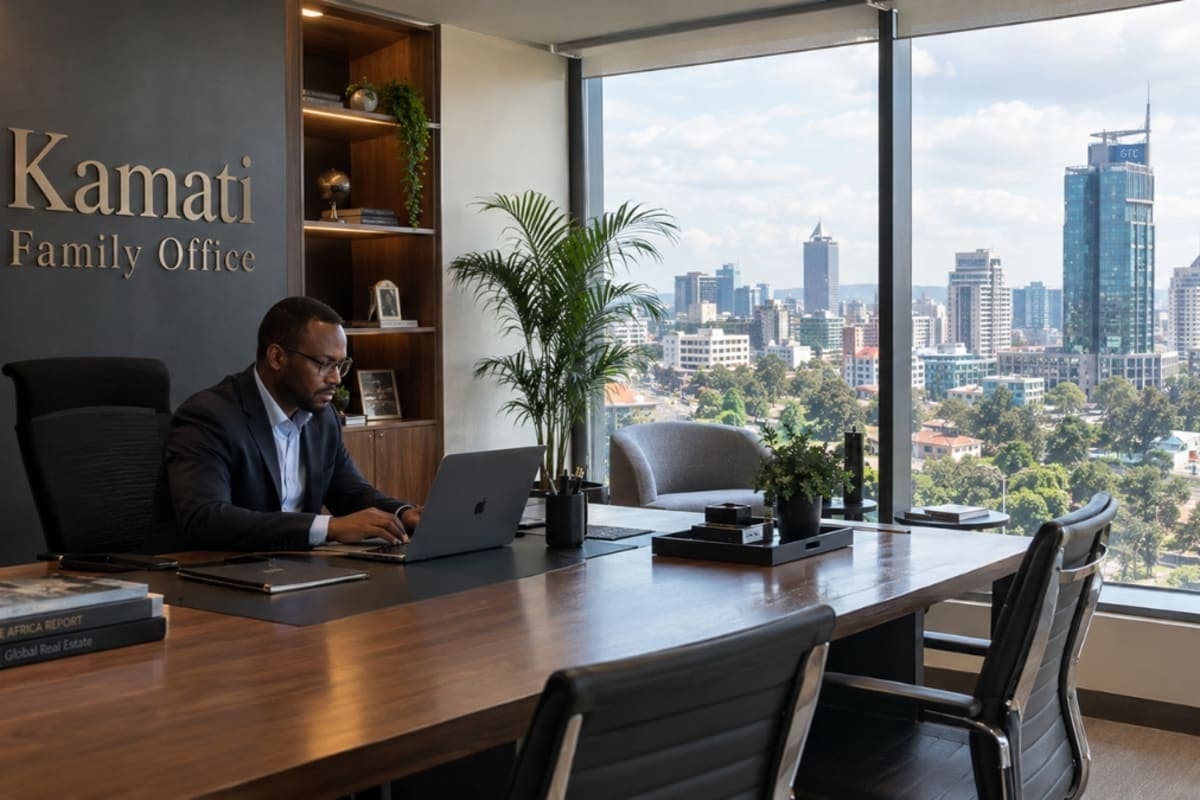

What is a family office?
A family office is a team of professionals hired by a wealthy family to manage its wealth, or a firm that offers those services to several families.
It covers investments, tax and legal work, estate planning, and philanthropy.
Why is it called a “family office”?
It is literally the office that runs a family’s money. The name describes the job, not a legal category.
John D. Rockefeller set up an office of professionals in 1882 to organise his complex business operations and investment needs.
This is widely seen as the model for today’s family offices.
The idea has older roots. According to Wikipedia, a household steward in the 6th century handled a royal family’s affairs and wealth.
Types of family offices
Single-family office (SFO): serves one family only, with a dedicated team.
Multi-family office (MFO): serves several families and shares costs between them.
Outsourced or virtual office: an outside provider delivers family office services to families who don’t want to build their own team.
How they differ from normal investment firms
Private equity firms raise money from outside investors and answer to them. Family offices answer to a family mandate.
Family offices are known for patient capital and often become long-term partners.
They mix financial goals with legacy, control, values, and privacy.
Institutional investors like pension funds manage pooled money under fiduciary and regulatory rules. Family offices invest for one family with more freedom.
An SFO is a cost centre funded by the family. An MFO is a business that charges fees, usually a percentage of assets.
Is there a minimum amount?
There is no legal minimum, only what makes economic sense:
SFO: Most experts suggest $100–250 million in investable assets, with running costs of roughly $1–3 million a year. Some sources put the threshold as high as $500 million.
MFO: Typically $10–25 million. Other sources say $25–50 million.
Below that: Most families use a wealth manager or an outsourced model.
Family offices in Kenya
Chandaria: Darshan Chandaria, CEO of Chandaria Industries, is setting up a family office to tighten governance and open a formal channel for outside investment. The group’s businesses include hygiene manufacturing, real estate, and financing. He also founded Chandaria Capital in 2017, a Nairobi venture fund.
JN Family Office: It manages the Ngaruiya family’s investments in Kenya and the US, across private equity, real estate, capital management, and farming.
Advisory support: The Institute for Family Business in Nairobi offers family office advisory services.
Wider picture: One analysis counts about 140 formal family offices in Africa, with the largest concentrations in South Africa, Nigeria, Kenya, Morocco, and Egypt.
Do Family offices focus on Commercial or residential?
It varies by region, and the data is mixed:
Global (Knight Frank survey): The top current real estate allocations are offices (20%), luxury residential (17%), industrial (14%), and hotels (12%).
North America (UBS/Campden, older): 56.6% of real estate went to commercial and 43.4% to residential.
German-speaking Europe: Residential is the largest share at 37.5% of real estate assets, ahead of offices at 25%.
Where they plan to add: Nearly 44% planned to increase real estate investment, with an emphasis on residential and industrial.
A 2025 report of 32 family offices found more than half of their wealth in real estate. That sample was German-speaking Europe only.
Related: Kenya’s Property Market Is Starting to Shift as Commercial Real Estate Attracts New Capital
Family offices vs institutional investors in real estate
Knight Frank’s 2026 Wealth Report says private capital has pulled ahead of institutions as the dominant force in prime commercial real estate.
Family offices can hold illiquid assets for decades. Institutional investors face liquidity pressure and benchmarking cycles.
Family offices tend to favour direct ownership. Around 80% of the German-speaking family offices’ investments are made without outside funds or intermediaries.
Many also work with institutions through co-investments and joint ventures.
Real examples
Global
Cascade Investment (Bill Gates): In 2021, it agreed to raise its Four Seasons stake from 47.5% to 71.25%, paying $2.21 billion for half of Kingdom Holding’s stake. It also bought the Four Seasons Hotel Atlanta and its office space for $62 million.
Kwok family (Sun Hung Kai Properties): Its private investment arm took a 50% stake in Goodluck Hope, a £500 million London docklands condo project, with developer Ballymore.
Kenya
Kenyatta family, Northlands City: A mixed-use development planned for an 11,000-acre farm in Ruiru, designed for a population of 250,000. This is a family land and business project, not a formal family office.
Humphrey Kariuki is believed to have set up a family office to manage his wealth.
Why this matters for real estate
Patient, long-horizon capital suits large land and mixed-use developments.
Direct deals mean less reliance on funds and more joint ventures with developers.
Families without formal structures are increasingly adopting them, partly to bring in institutional partners.
For developers and platforms, family offices are a growing source of capital to understand.