
If you're renting in Nairobi, you're paying less than tenants in many of Africa's major cities, according to the latest 2026 Cost of Living Index by Numbeo.
While the cost of living continues to rise across the continent, Nairobi remains relatively affordable, particularly in terms of housing.
How the Index is Calculated
Numbeo's Rent Index compares average rental prices in cities around the world using New York City as the benchmark (100).
According to Numbeo, Nairobi has a Rent Index of 11.1, which means renting an apartment in the Kenyan capital costs roughly 89% less than in New York City.
Of course, comparing Nairobi to New York is a bit crazy, but the index is useful for seeing how Nairobi compares against other African cities.
Comparing Nairobi and Other Major Cities in Africa
The table below shows how some selected African cities compare on the Rent Index against Nairobi:
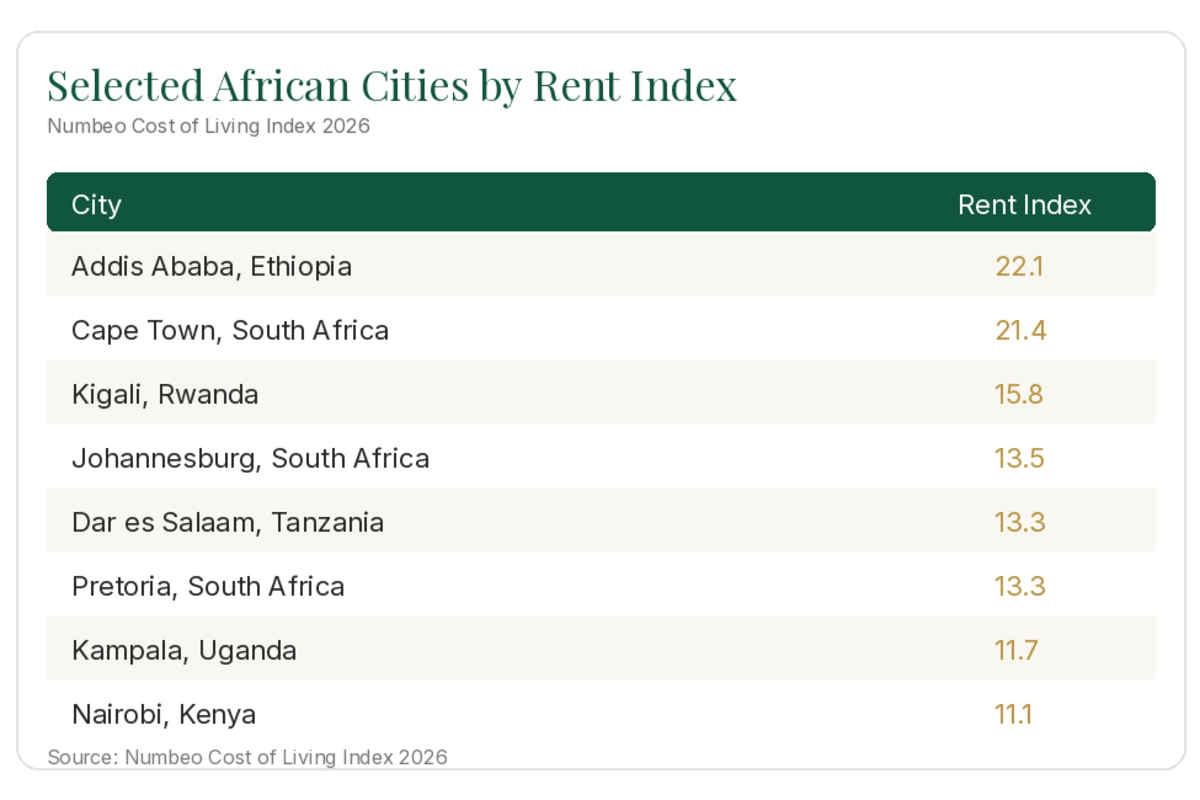
The figures show that Nairobi's rental market is cheaper than those in Addis Ababa, Cape Town, Johannesburg, Dar es Salaam, and even Kampala, although it is not the lowest on the continent.
What About the Cost of Living?
Housing is only one part of the equation.
The report also ranks cities based on everyday expenses such as groceries, transport, utilities, and dining out.
Nairobi records a Cost of Living Index (excluding rent) of 32.0. That places it:
Below Addis Ababa (42.6), meaning everyday expenses are generally lower in Nairobi.
Above Dar es Salaam (28.8) and Kampala (27.6), making those cities slightly cheaper for day-to-day living.
Lower than major South African cities such as Johannesburg (40.4) and Pretoria (41.6).
In other words, Nairobi sits somewhere in the middle.
It isn't the cheapest city in East Africa, but it remains more affordable than many of Africa's larger commercial hubs.
What's interesting is how expensive Addis Ababa is.
What This Means for Renters
For people moving to Nairobi, the report suggests the city continues to offer relatively affordable rental options compared to many other African capitals.
Of course, rent varies significantly depending on the neighbourhood.
Areas such as Kilimani, Westlands, and Kileleshwa command higher prices, while estates further from Nairobi generally offer better value. Which is true.
Check out our rent vs buy calculator to see if you are better off renting rather than buying.
The closer you are to the city, the more expensive your rent will be.
Good example. A 2-bedroom apartment in Kilimani will cost about Ksh 90,000 per month, while a similar apartment (same size) in an area like Syokimau will cost about Ksh 50,000 and around Ksh 35,000 in an area like Mirema.
While affordability challenges remain for many households, the city still compares favourably with several major African capitals when it comes to the cost of renting.
For home seekers, investors, and anyone planning a move, the figures reinforce Nairobi's position as one of East Africa's more competitive rental markets, especially if the development is on the outskirts of the city.