
What is a REIT?
A Real Estate Investment Trust (REIT) is an investment vehicle that pools money from many investors to buy, own, or finance income-generating properties. The properties are managed by professionals, and investors earn a share of the income generated through dividends.
In short, it is a way for people to invest in expensive real estate without having to buy the entire property on their own.
Instead of buying an entire office block or mall directly, you purchase units of the trust. The trust then distributes the generated rental income or capital gains back to you as dividends.
Now, a REIT can be publicly listed on a stock exchange or 'public', but not listed.
You can have a publicly listed REIT, which is listed on the Nairobi Securities Exchange (NSE), or you can have a REIT that is not listed but is publicly traded. This means the Capital Markets Authority regulates them; you can buy units through a broker, but they are not listed on the NSE.
REITs listed on the NSE are highly liquid, as you can easily buy and sell units, compared to the public but not listed REITs that are a bit tedious to buy or sell.
An example of a publicly traded REIT is the newly listed TRIFIC Green USD Income REIT, while the ILAM Fahari I-REIT is a public REIT but not listed on the exchange.
Why Invest in REITs in Kenya?
High Dividend Payouts: By Kenyan law, income-focused REITs must distribute at least 80% of their net after-tax profits to unitholders annually.
Portfolio Diversification: They provide instant exposure to institutional-grade commercial, residential, and industrial real estate. A good example is the TRIFIC Green USD Income REIT, which offers grade A offices in Two Rivers.
Inflation Hedge: Rental property prices and lease agreements in Kenya typically rise alongside inflation, protecting your purchasing power.
Liquidity: Selling physical real estate takes months; selling listed REIT units on the NSE takes just a few clicks.
Types of REITs Authorized in Kenya
The Capital Markets Authority (CMA) regulates three primary categories of REITs:
Income REITs (I-REITs): These focus on acquiring completed, long-term income-generating real estate (such as commercial offices, student housing, or shopping malls). They generate returns primarily through consistent rental distributions.
Development REITs (D-REITs): These focus on pooling capital to acquire land, undertake development, and complete construction projects. Units are usually restricted to professional investors due to construction and market risks. However, Acorn launched a platform called Vuka where an individual with as little as Ksh 5,000 can put money in, and it is aggregated with other investors into a pool.
Islamic REITs: A unique, Shari'ah-compliant investment vehicle. A fund manager ensures all underlying real estate assets exclude non-permissible activities (e.g., structures housing casinos or bars).
How the Kenyan REIT Structure Works
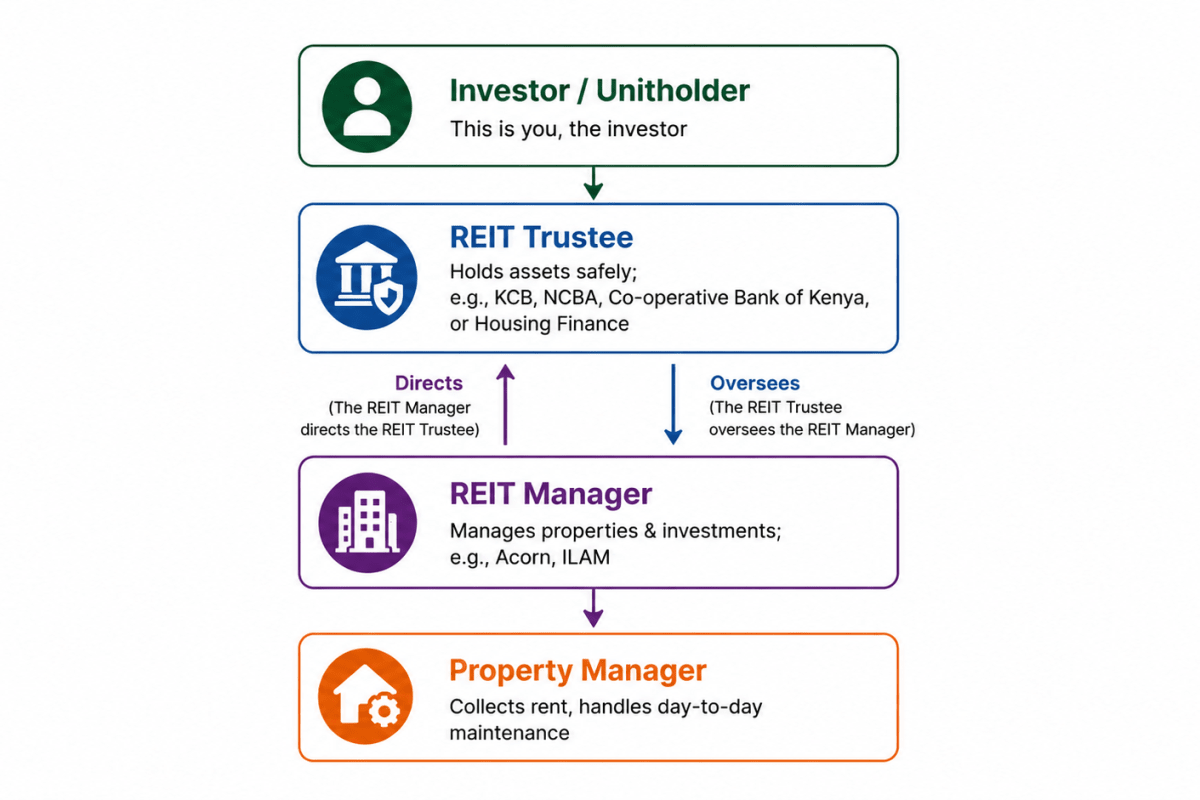
To protect your money, the CMA enforces a strict four-tier corporate governance structure:
Tax Advantages of Kenyan REITs
Investing in REITs offers massive structural tax exemptions compared to standard corporate structures:
Corporate Income Tax Exemption: Qualifying REITs pay 0% corporate tax (saving them from Kenya's standard 30% rate). The profit after expenses is what is paid out to investors, who then only pay withholding tax as described below
Capital Gains Tax (CGT) Exemption: Transferring properties into a certified REIT scheme is generally exempt from CGT. This reduces the cost and complexity of setting up a REIT
Stamp Duty & VAT Exemption: Certain property transfers into an approved REIT may be exempt from stamp duty and VAT, again simplifying and making it easier to expand a REIT
Investor Tax Note: Investors only pay withholding tax on their final interest income or dividend payouts.
How to Invest in REITs in Kenya
Step 1: Open a CDSC Account
You need a Central Depository and Settlement Corporation (CDSC) account to hold listed securities. You can open one through any licensed stockbroker or via mobile investment apps like Vuka, or through a bank.
Step 2: Fund Your Brokerage Account
Deposit your investment capital via M-Pesa, bank transfer, or RTGS into your broker’s designated client bank account.
Step 3: Select and Order Your REIT Units
Search for listed REIT tickers on your broker's platform. Place either a Market Order (to buy immediately at the current price) or a Limit Order (to buy only when the price drops to your target).
Current List of REITs in Kenya
The Kenyan REIT market has recently expanded with innovative multi-currency and sustainable listings on the Nairobi Securities Exchange:
ILAM Fahari I-REIT: An income-generating portfolio managed by ICEA Lion Asset Management. It features commercial retail spaces and offices.
Acorn Student Accommodation I-REIT (ASA I-REIT): Focused on yielding consistent rental income from highly occupied purpose-built student housing.
Acorn Student Accommodation D-REIT (ASA D-REIT): Restricted largely to professional/institutional investors to finance the construction phase of new housing projects.
TRIFIC Green USD Income REIT: Newly listed on the NSE, this marks Kenya's first US Dollar-denominated sustainable green REIT, raising over KSh 4 Billion to capture eco-friendly commercial real estate demand.
Key Market Challenges to Keep in Mind
High Minimum Caps for Unlisted REITs: Participating in private placement D-REITs requires a steep entry threshold of KSh 5 Million, shutting out retail investors. However, as earlier explained, Acorn came up with Vuka to aggregate small investors.
Limited Liquidity: Because the local REIT market is small compared to traditional equities like buying shares from Safaricom or Equity, buying or selling large blocks of units can take time.
Strict Trustee Capitalization Requirements: Trustees must maintain KSh 100 Million in minimum capital, which limits management to a small pool of commercial banks.